The Hollow at the Center
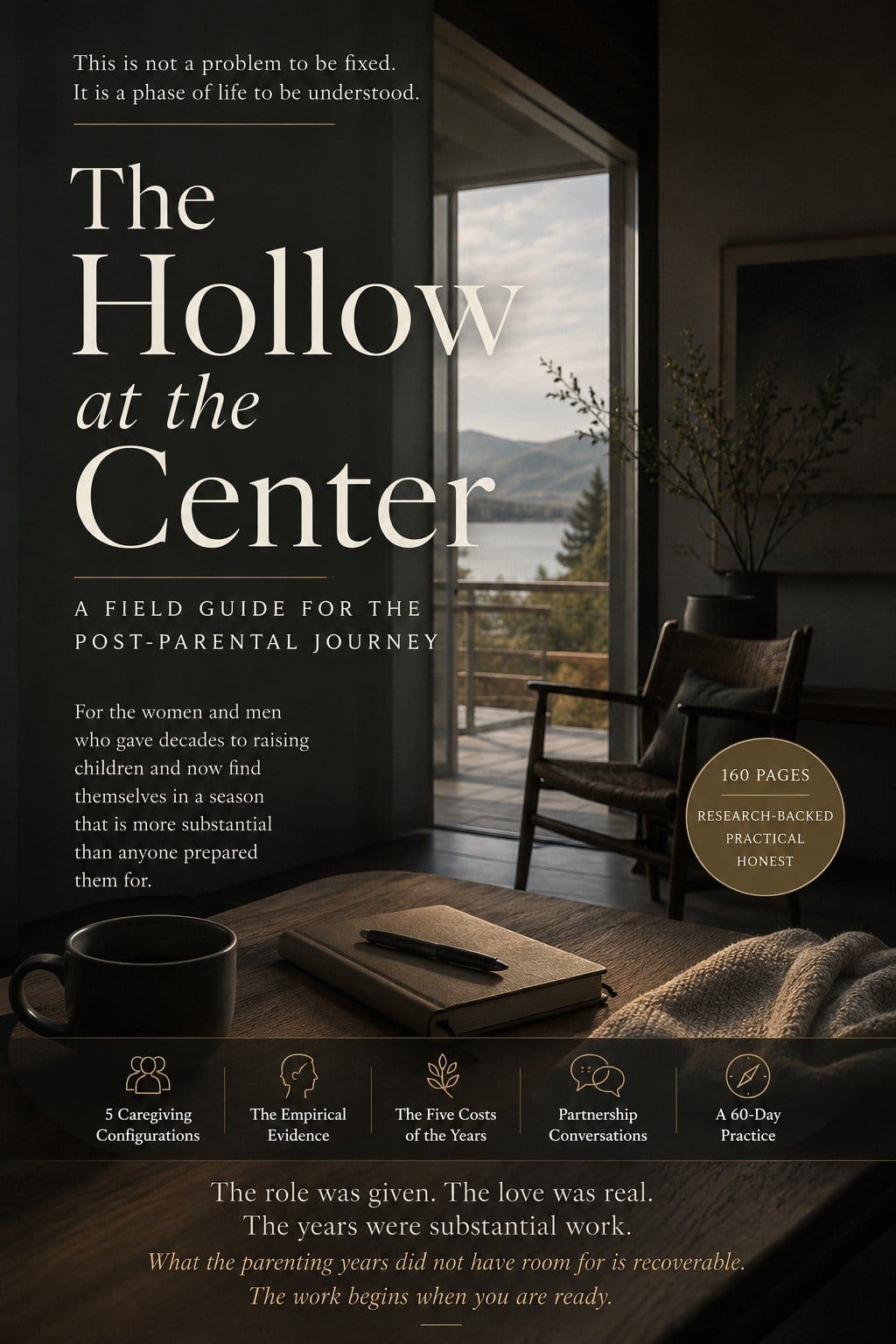
You did not pick up this book because the period after your children left home has been an entirely uncomplicated experience. You picked it up because some quality of your daily reality has, by now, become unmistakable, and you have begun to suspect that what is operating is not, in fact, a personal failure to adjust gracefully — not a problem to be fixed by booking a vacation, taking up a hobby, or scheduling more date nights — but something more like a structural reckoning with the configuration of self that has been organizing your interior life for the better part of two or three decades. The popular framings have not, in most readers' experience, been adequate to the territory. The phrase "empty nest syndrome" has, on examination, both pathologized the experience as a clinical condition to be efficiently overcome and trivialized it as a passing sadness that organized vacations and renewed hobbies will quickly resolve. Neither framing has accurately described what most readers find themselves in. The reinvention narratives — "rediscover yourself," "embrace your second act," "this is your time now" — have produced, for many, temporary engagement that has not addressed the underlying reckoning the period is, in fact, requiring. The Hollow at the Center is a 160-page field guide for the women and men who organized two or three decades of life around the raising of children, who now find themselves in houses gone unfamiliarly quiet, and who are ready — though they did not, in most cases, ask to be ready — to sit with the question of who, structurally, they have been beneath the role. Drawing from the empirical research of Erik Erikson, Bernice Neugarten, Ravenna Helson and the Mills Longitudinal Study, and the broader literature on adult development and midlife transition, this book treats the post-parental period as the substantial developmental phase it is — neither pathology nor trifle, but a period of identity reorganization comparable in scope to the major transitions of adolescence and early adulthood. Inside, you will find: The five configurations of the caregiving years — Primary Caregiver, Working Parent, Sandwich Generation Parent, Single Parent, Distant Parent — and the recovery work each one calls for What the empirical literature actually says about the post-parental period — average flourishing, substantial individual variation, partnership outcomes including gray divorce, fathers' late-onset effects, the specific work that determines outcomes The five costs the parenting years produced across decades — professional development reduced or paused, interior life crowded out, friendships sustained at reduced levels, the body systematically deprioritized, the deferred questions The adult children recalibration — authority, involvement, advice, emotional configuration; what conversations are still available and what configuration of post-parental relationship is, in fact, settling in The partnership conversations that the post-parental period is asking for — sustained, honest, sometimes uncomfortable, foundational to whatever configuration the partnership will, in fact, sustain across the second half of life The body in late midlife — perimenopausal and postmenopausal transitions, the autonomic recalibration, the comprehensive medical examination as foundational early move Mortality, finitude, and what the empty house is, in fact, asking — addressed directly rather than displaced into reinvention narratives A 60-day practice — eight weeks plus integration days, designed to translate the work into daily life This book speaks primarily to mothers, who in most contemporary configurations have served as primary caregivers and who, accordingly, encounter the period with particular intensity — while remaining inclusive of fathers, same-sex partnerships, adoptive parents, stepparents, and other parental configurations. The Hollow at the Center does not promise that the post-parental period will become, with the work, the best period of your life. The honest position is more substantial: that the dimensions of self the parenting years did not have room for are recoverable in most cases, that the work is the work of years rather than months, and that the period after the children leave is a more substantial site of human development than the popular framings have generally allowed. The role was given. The love was real. The years were substantial work. What the parenting years did not have room for is recoverable. The work begins when you are ready.
Author: Elena Marsh